[EN]


Planning a first ski holiday in the French Alps can feel more complicated than it needs to be. Which resort should you choose? How important is altitude? Should you book a catered or self-catered chalet? Do you need a car? How do ski passes and lessons work in France? And how much should you actually budget beyond the cost of your accommodation?
The answers depend less on finding the “best” resort than on understanding what matters to your particular group. A family travelling with children and grandparents will have very different priorities from a group of experienced skiers who expect to spend every day exploring the mountain.
This guide walks through the main decisions in order, from choosing a resort and chalet to organising transfers, lessons and meals. It is designed particularly for first-time visitors to the French Alps, whether you’re travelling from London, New York, Toronto, Singapore, Cape Town or São Paulo.
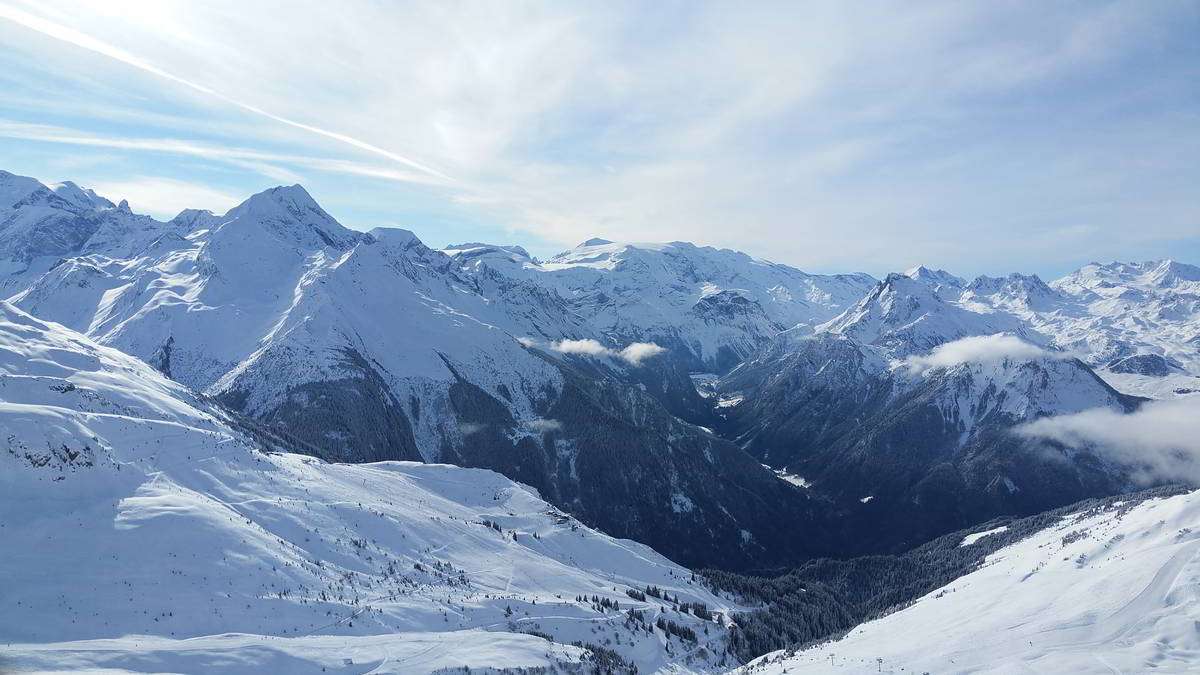
Choosing the right ski resort in the French Alps
There is no single “French Alps experience”. Resorts differ considerably in altitude, ski area size, architecture, atmosphere, accessibility and price. Before focusing on the names you already know, it is worth deciding what you actually want from your week.
How much skiing do you want? Some resorts are part of enormous interconnected ski areas offering hundreds of kilometres of linked slopes. For confident skiers who enjoy exploring somewhere different every day, the size and connectivity of the ski area can matter considerably. Other groups may spend only part of each day skiing, in which case access to gentle slopes, restaurants and non-ski activities may matter more than the total number of kilometres.
What kind of resort atmosphere are you looking for? French ski resorts range from traditional Alpine villages to purpose-built high-altitude stations designed around convenient access to the slopes. Some destinations are particularly known for restaurants, boutiques and après-ski; others put more emphasis on skiing, space and family activities. Neither model is inherently better.
Who is travelling with you? This is often the most useful question. A group of experienced skiers may prioritise terrain and lift connections. Families with young children may care more about ski schools, easy pistes and short journeys between the chalet and the slopes. A multigenerational group should also consider what grandparents, non-skiers and younger children will do during the day.
How important is the chalet itself? If the accommodation is simply somewhere to sleep between ski days, location may dominate your decision. If twelve or fifteen people are spending a week together, the chalet can become a major part of the holiday: large communal spaces, en-suite bedrooms, a swimming pool, wellness facilities and areas where different generations can spend time separately all start to matter.
Finally, consider the total budget rather than the accommodation price in isolation. Resort reputation can have a substantial impact on chalet prices. Two properties offering comparable space and facilities can sit in very different price brackets simply because they are located in different resorts.
Rather than choosing a resort on name recognition alone, compare the ski area, altitude, accommodation, atmosphere, needs of your group and overall holiday budget together.
If you are considering some of the best-known French resorts, our detailed comparisons of La Plagne vs Courchevel and La Plagne vs Méribel look at these differences side by side.
What to look for in a luxury ski chalet
Once you have narrowed down the destination, choosing the chalet is the second major decision. Photographs are useful, but they rarely tell you everything you need to know about how a property will work for a group over an entire week.
Start with location and genuine access to the slopes. “Close to the slopes”, “ski access” and “ski-in/ski-out” can describe very different situations. Check the actual distance, whether it is walkable in ski boots, whether a shuttle is required and how easily children or less confident skiers can make the journey.
Then look carefully at the bedroom configuration. A seven-bedroom chalet does not necessarily work equally well for seven couples, several families or a multigenerational group. Check which beds can be configured as twins or doubles, whether every bedroom is genuinely en-suite, and whether additional capacity depends on sofa beds or temporary sleeping arrangements.
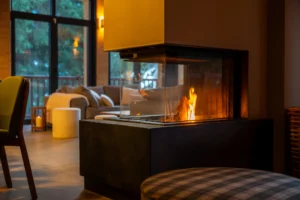
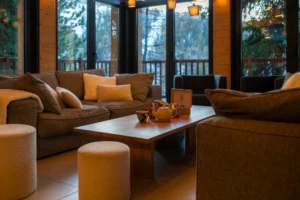
Communal space is just as important as bedroom count. A chalet may technically accommodate 14 or 15 people but still feel crowded if everyone has to use one relatively small living area. Look at the size and layout of the main living room, dining table and kitchen, but also whether there are alternative spaces such as a cinema room, games area or quiet corner. Larger groups often value the ability to spend time apart almost as much as the opportunity to gather together.
For pools and wellness facilities, check whether they are completely private. A photograph of an indoor pool can look impressive without making clear that it belongs to a shared residence or apartment complex. The same applies to saunas, hammams, hot tubs and fitness rooms.
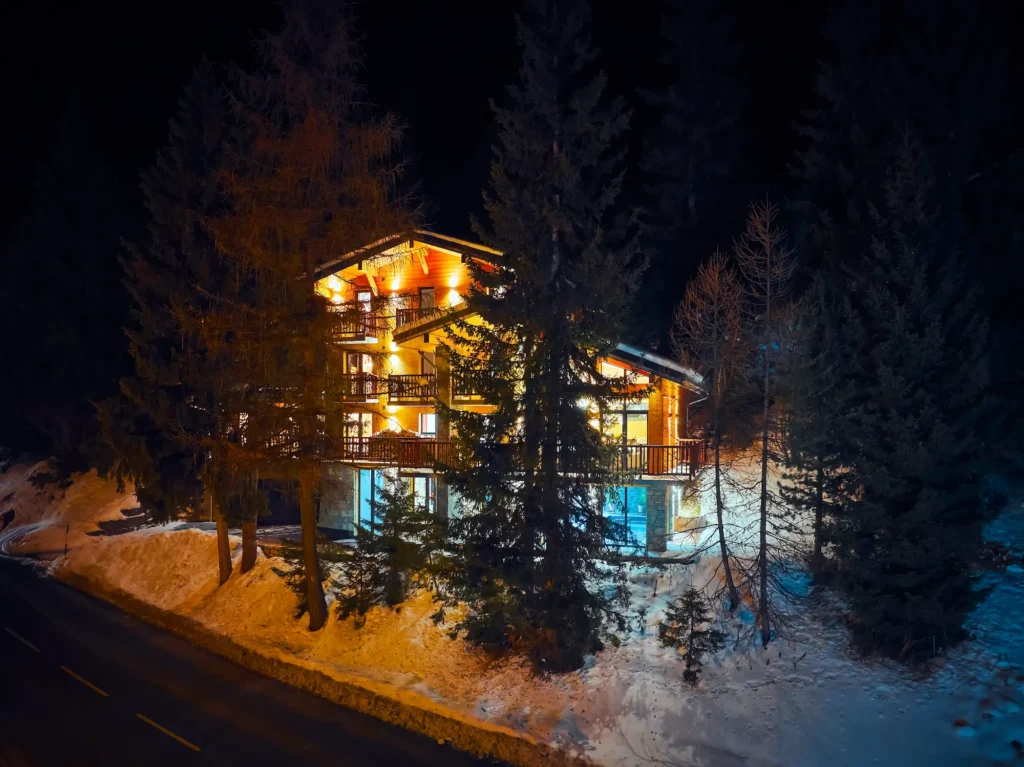
Practical details matter too. A proper ski room, boot storage and drying facilities make mornings easier. Parking may matter if you are driving. Families may want to check for cots, high chairs, children’s games and safe spaces away from stairs or pool areas.
Then consider the level of service and flexibility. Is there someone who can organise ski lessons, restaurant bookings, transfers or a private chef? Are services included in the price or arranged separately? Can you choose them individually, or are you buying a fixed package whether you need everything or not?
Finally, look for evidence beyond the property’s own photographs and description. Official classifications, independently verified guest reviews and a consistent history of feedback can help distinguish an established property from one relying entirely on marketing language.
In short, compare what you will actually use for seven days: the real sleeping arrangements, communal space, privacy, access to the slopes, facilities and service — not simply the number of amenities listed.
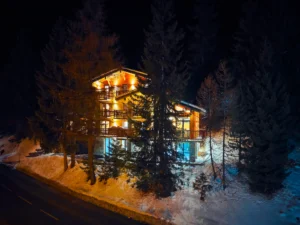
Chalet du Bois Melay in La Plagne 1800 is one example of this type of large private chalet, with seven en-suite bedrooms, a private heated indoor pool and an official 5-star classification. See what genuinely defines a premium chalet in the French Alps..
Understanding altitude and snow conditions
Altitude is one of several factors to consider when comparing ski resorts, particularly if you are travelling near the beginning or end of the winter season. It should not, however, be reduced to a simple rule that “higher is always better”.
Look at both the altitude of the village and the altitude of the ski area. A village may sit relatively low while lifts provide rapid access to much higher slopes. Exposure, the proportion of high-altitude pistes and snowmaking infrastructure also influence skiing conditions.
This is why comparing only the altitude printed next to a resort’s name can be misleading.
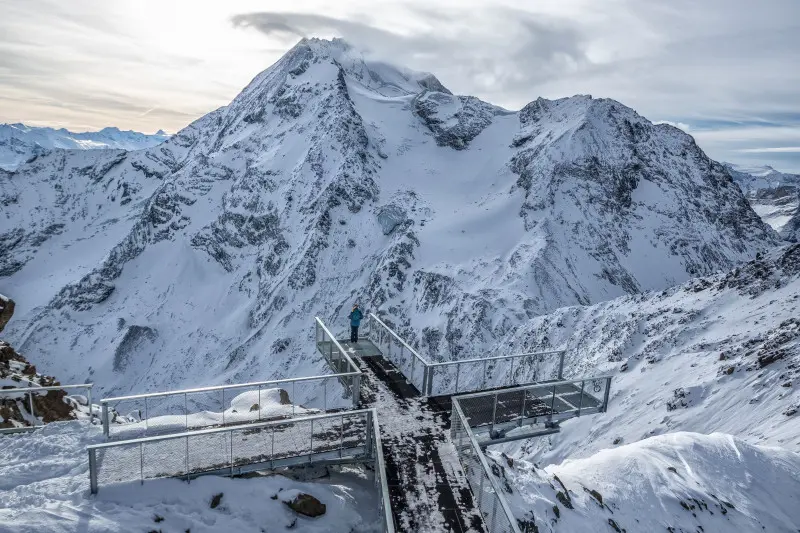
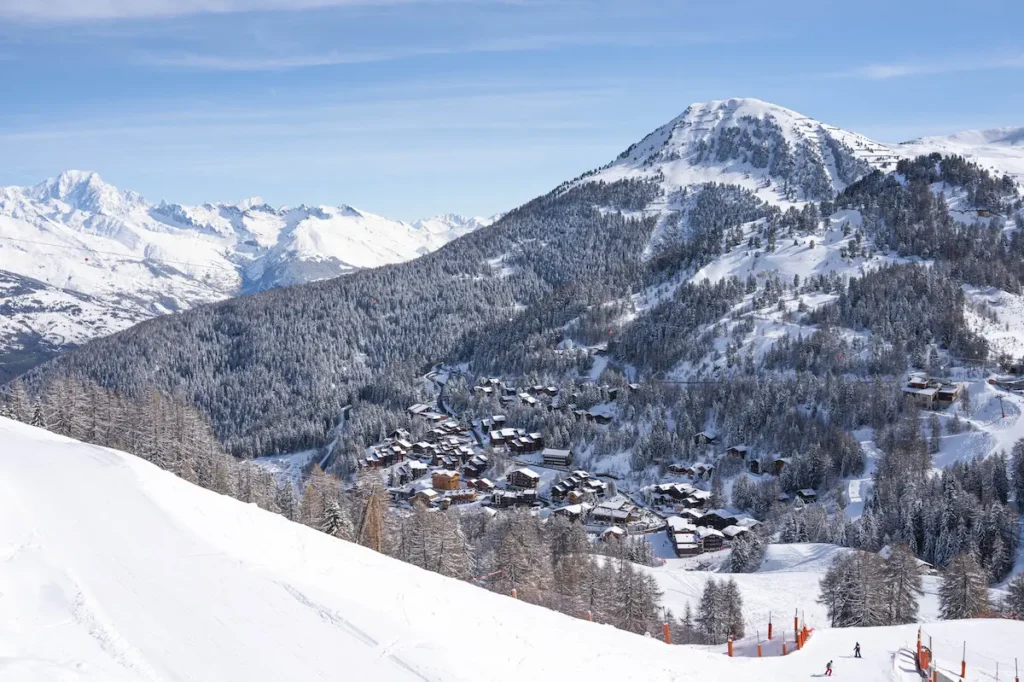
La Plagne provides a useful example: its villages are spread across different altitudes, while its ski area reaches above 3,000 metres and more than 70% of its pistes are above 2,000 metres. When comparing resorts, this distribution across the mountain is often more informative than the altitude of your accommodation alone.
For a first visit, the practical question is therefore not simply “How high is the resort?” but “At what altitude will we actually be skiing, and how easily can we reach those slopes?”
Understanding French ski areas and lift passes
The scale of French ski areas can initially be confusing because the name of your resort is not necessarily the same as the name of the entire ski domain you can access.
A resort will usually offer a pass covering its own ski area, while larger interconnected domains may offer a broader pass connecting several resorts. Which one makes sense depends largely on your level and how much terrain you expect to explore.
Beginners and families spending most of their time close to the resort may have little reason to pay immediately for the largest possible area. Stronger skiers staying for a full week may value the freedom to move between different sectors and resorts.
Paradiski illustrates the principle well. It connects La Plagne, Les Arcs and Peisey-Vallandry via the Vanoise Express and provides 425 km of interconnected pistes. A skier based in La Plagne can therefore choose between skiing the La Plagne area itself or buying access to the wider Paradiski domain.
Lift passes can generally be bought online before travelling or in the resort. For first-time visitors, checking the different pass options before arrival is worthwhile: the most extensive pass is not automatically the most appropriate one for every member of a mixed group.
For maps, sectors and a more detailed explanation of the area, see our dedicated Paradiski guide.
Getting to the French Alps: airports, transfers and rental cars
For international visitors, the journey to the mountains is an important part of the planning process. Geneva and Lyon are two of the main gateways to the French Alps, while Chambéry can also be convenient when suitable flights are available.
Flight schedules change from one winter to another, particularly for seasonal and long-haul routes. If you are travelling from North America or another long-haul market, check the current routes for your exact dates rather than assuming that a direct service available one season will operate the next.
Once you land, there are three main options: a private transfer, a shared transfer or a rental car.
For a group occupying an entire chalet, a private transfer can be particularly convenient. Everyone travels together, luggage is handled once, and there is no need to drive on unfamiliar mountain roads after a flight. It also removes the question of parking once you arrive.
A rental car makes more sense if you expect to explore outside the resort, visit several valleys or remain mobile during your stay. Remember, however, to check winter equipment requirements, parking at the chalet and whether you will actually use the vehicle once skiing begins.
Train travel can also be worth considering, particularly if you are travelling from London, Paris or elsewhere in Europe. Several Alpine valleys are served by rail, with the final journey to the resort completed by taxi or private transfer. When comparing routes, look at the total door-to-door journey rather than the flight or train time alone.
For a traditional seven-night chalet holiday where most activities take place in the resort, many visitors find that arranging the airport transfer in advance and then relying on local transport is simpler than keeping several cars unused for a week.
Catered or self-catered: which is right for you?
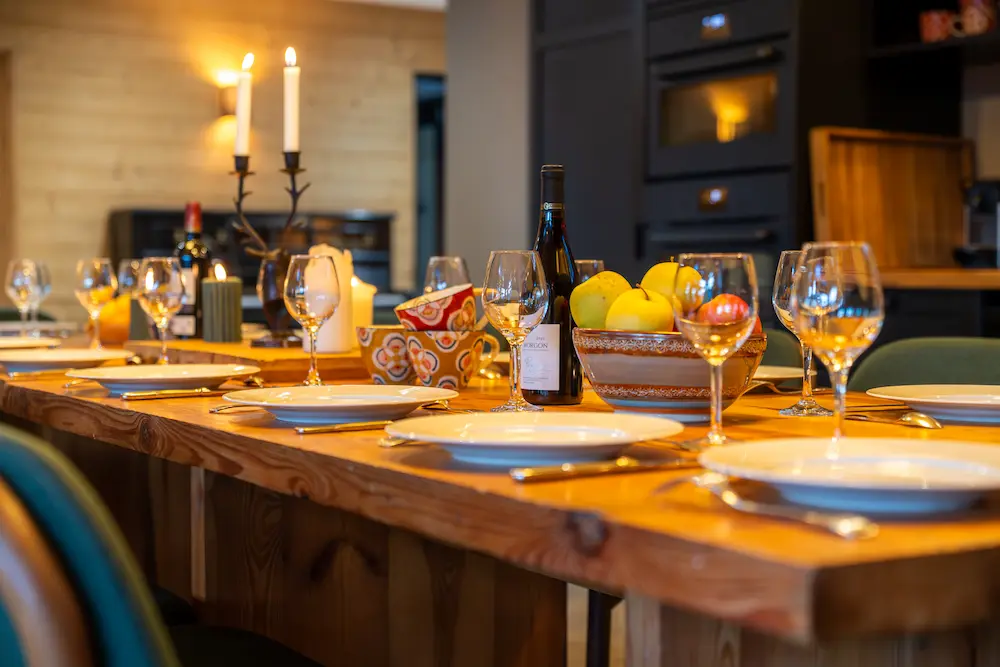
Chalet holidays in France do not have to mean choosing between two rigid formulas. In practice, there is a spectrum between a completely self-catered stay and having every meal prepared for you.
A fully catered chalet generally suits guests who want food to be part of the service throughout their stay and prefer not to think about shopping, cooking or clearing up.
A private chef on selected evenings provides a different type of flexibility. You might cook or eat out for part of the week and arrange a chef for a celebration or after a particularly long ski day.
Meal delivery sits somewhere between the two, while a self-catered chalet gives the group complete independence — particularly attractive when the property has a large, well-equipped kitchen.
Think about the rhythm of your group rather than assuming the most expensive formula is automatically the most appropriate. A group containing children, keen cooks, restaurant lovers and people with different schedules may actually value flexibility more than a fixed catering programme.
For larger groups, it is also worth checking whether someone can organise these different options for you before arrival.
Our catered or self-catered chalet guide explains the different possibilities in more detail.
Booking ski lessons and equipment
Ski lessons and equipment are relatively easy to organise in France, but peak weeks reward advance planning.
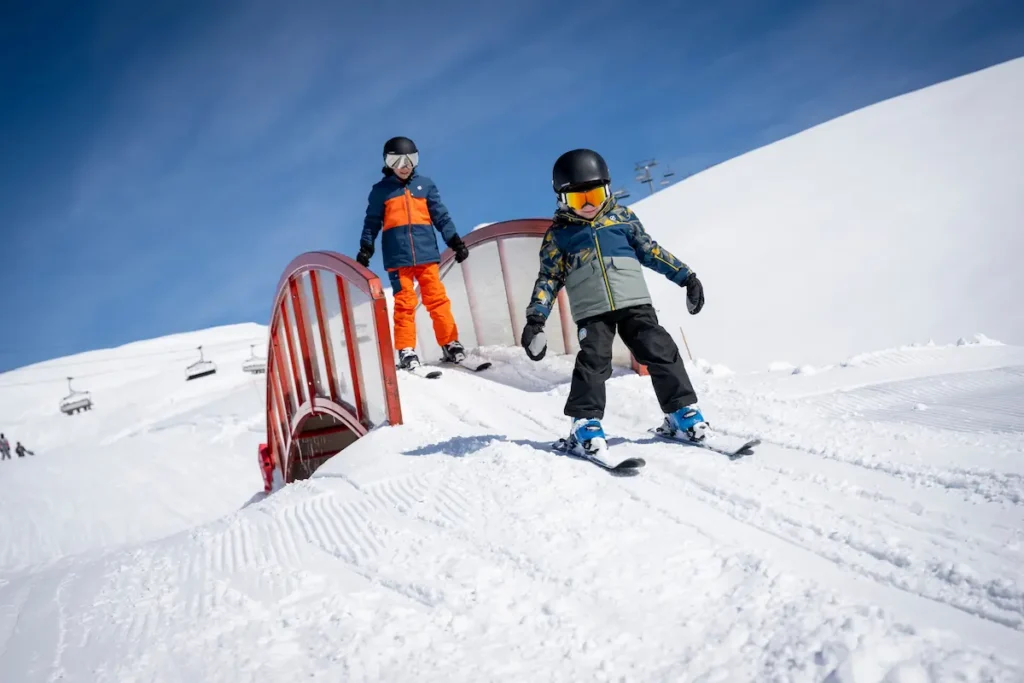
Most large resorts have several ski schools. ESF (École du Ski Français) is the best-known network, alongside independent schools and private instructors. Both group and private lessons are widely available.
Group lessons can work well for children and adults who enjoy learning with others and want to keep costs under control. Private lessons offer more flexibility over pace, meeting point and objectives, and can be particularly useful for complete beginners, families wanting to ski together or experienced skiers looking for guidance around an unfamiliar area.
Check lesson times before finalising other arrangements. Children’s classes, restaurant bookings and family plans are much easier to coordinate when you know when everyone needs to be at the ski-school meeting point.
Equipment can usually be reserved online before arrival and collected in resort. Some providers also offer chalet delivery and fitting, which can save a considerable amount of time for a large group. Check what is included — skis or snowboard, boots, poles and helmet — and whether equipment can be exchanged easily if the fit is not right.
For Christmas, New Year and school-holiday weeks, book private lessons and specialist childcare early rather than leaving them until arrival.
What if not everyone in your group skis?
This matters more than it may appear when choosing a chalet and resort. A group of 12 to 15 people rarely has 12 to 15 guests who want to ski from the first lift to the last every day.
Some may not ski at all. Others may take lessons in the morning and prefer a different activity in the afternoon. Grandparents may want to join the family for lunch without skiing all day.
Look therefore at the destination from a non-skier’s perspective as well. Depending on the resort, possibilities may include pedestrian-accessible mountain restaurants, snowshoeing, winter walks, spa treatments, swimming, local markets, restaurants and other mountain activities.
The chalet itself can also make a significant difference. A private pool, sauna, cinema, comfortable living spaces and good views mean that staying “at home” for an afternoon does not feel like missing the holiday.
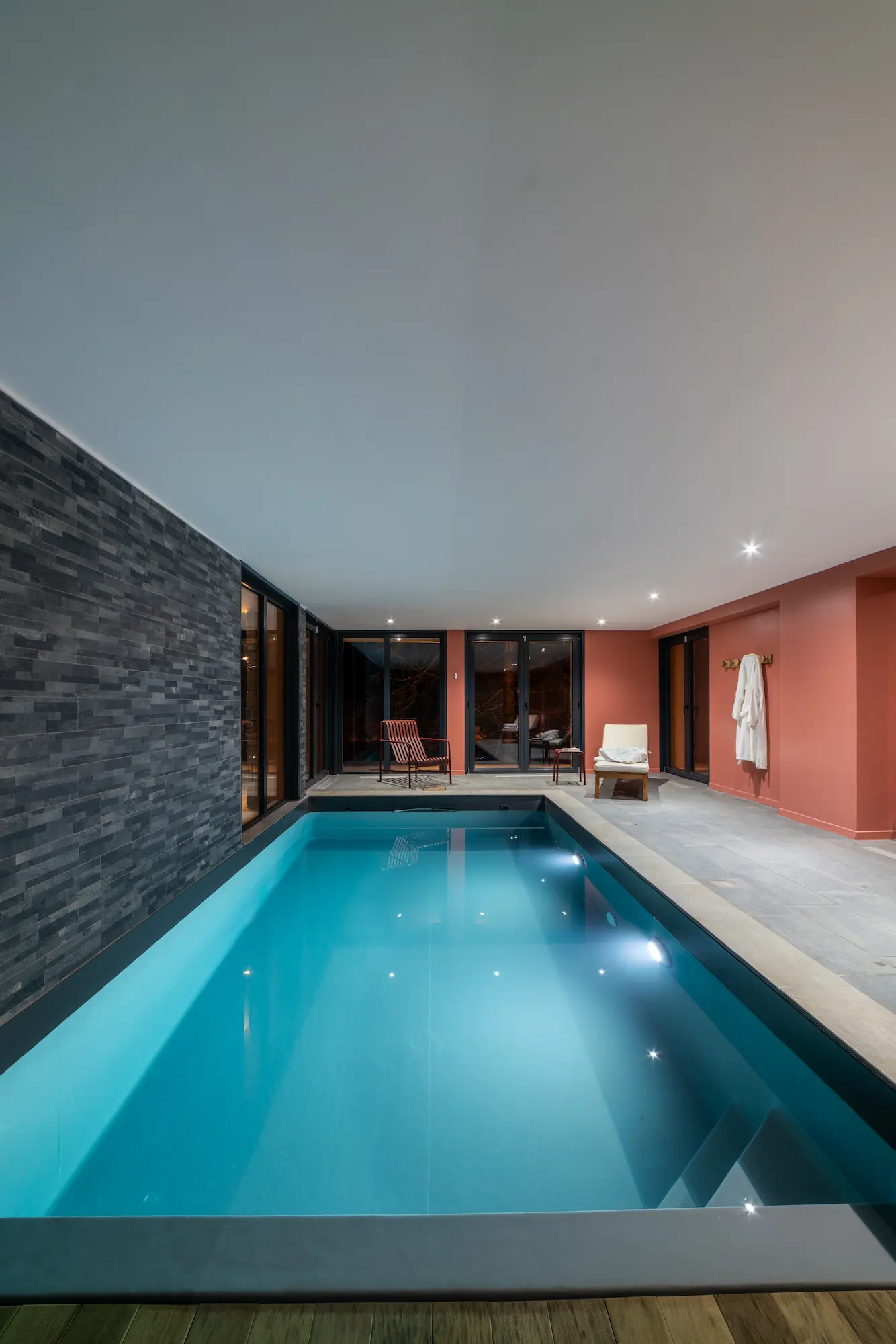
This is particularly important for multigenerational groups: the best base is often one that allows everyone to follow a different rhythm and still come together naturally later in the day.
See how private wellness facilities at Chalet du Bois Melay can work for skiers and non-skiers sharing the same holiday.
How much should you budget for a luxury ski holiday?
There is no useful single figure for a luxury ski holiday in the French Alps. The total can vary considerably according to resort, dates, group size, chalet and level of service.
Instead, build the budget from its main components:
- Accommodation — usually the largest expense and highly sensitive to both the week and the resort
- Airport transfers — private or shared, return
- Ski passes — which depend on age, duration and ski area
- Equipment rental — skis or snowboard, boots and helmet
- Lessons — private tuition can become a significant budget item for several family members
- Food — groceries, restaurants, delivered meals or private-chef services
- Additional services — childcare, housekeeping or concierge services where applicable
- Non-ski activities — spa treatments, excursions and other experiences
When comparing accommodation, calculate the cost for the whole group, not just the headline weekly price. A larger chalet may appear expensive until the cost is divided between several families or couples.
Also consider what might be called the resort premium. Accommodation prices do not reflect the chalet alone. The reputation and positioning of the resort itself can materially influence what you pay for a property with a given number of bedrooms and amenities.
This is particularly relevant if your priorities are a large private chalet, swimming pool or spa facilities and access to a major ski area rather than being in a particular famous postcode. Comparing equivalent accommodation across several resorts can reveal substantial differences.
The useful question is therefore not “Which resort is cheapest?” but: what combination of chalet, ski area, services and location am I getting for the total cost of the holiday?
That is a much better basis for comparing value at the upper end of the market.
Our comparisons of La Plagne vs Courchevel and La Plagne vs Méribel provide concrete examples of how accommodation, ski area and resort positioning can produce very different overall propositions.
When is the best time to go — and how early should you book?
The French ski season broadly runs from December into April, but the experience changes significantly during those months.
Christmas and New Year combine skiing with the festive atmosphere many international families are looking for. They are also among the most sought-after weeks of the season, so chalet choice becomes limited early.
January is generally quieter outside the New Year period. Days are shorter and temperatures can be lower, but guests who value quieter slopes and resorts may find it particularly attractive.
February is one of the busiest periods because of school holidays in France and elsewhere in Europe. The exact holiday dates vary by country and region, which means demand can remain high across several consecutive weeks.
March brings longer days and a different rhythm on the mountain. Sunny terraces and later afternoons become a larger part of the experience, while high-altitude skiing remains an important consideration when choosing a destination.
April brings spring conditions and an increasing difference between lower and higher parts of the mountain. If travelling late in the season, look particularly carefully at the altitude and layout of the ski area rather than simply the resort village.
How early should you book? There is no universal deadline, but the less flexible your requirements, the earlier you should start. A large chalet for several families during Christmas week, combined with several private instructors, is much harder to arrange at short notice than a flexible January trip for four.
For peak weeks, securing the accommodation first and then arranging lessons, transfers and other limited-capacity services is generally the most practical sequence.
Your French Alps ski holiday checklist
- ✓ Does the ski area suit everyone in your group?
- ✓ Have you looked at the altitude of the ski area, not just the village?
- ✓ Does the chalet genuinely work for your group’s bedroom configuration?
- ✓ How far is it really from the slopes?
- ✓ Are pool and wellness facilities private or shared?
- ✓ Do you want a catered stay, self-catering or a flexible combination?
- ✓ Have you arranged airport transfers or checked car and parking requirements?
- ✓ Do children or beginners need lessons — and have you reserved them for peak weeks?
- ✓ Have you booked equipment or checked whether chalet fitting is available?
- ✓ Is there enough to do for guests who do not want to ski every day?
- ✓ Have you calculated the total holiday budget rather than accommodation alone?
- ✓ If you are travelling at Christmas, New Year or during school holidays, have you booked the limited-capacity services early?
A well-planned ski holiday does not require organising every hour in advance. The aim is simply to make the decisions that are difficult to change once you arrive — resort, chalet, transport and key bookings — while leaving enough flexibility to enjoy the week at your own pace.
FAQ
Do I need to speak French to plan a ski holiday in the French Alps?
No. English is widely used by ski schools, accommodation providers and tourism services in major French Alpine resorts, particularly those welcoming an international clientele. Learning a few basic French phrases can still be useful during your stay.
Is a rental car necessary for a French Alps ski holiday?
Not necessarily. For a chalet-based holiday where most activities take place in the resort, an airport or train-station transfer combined with local transport is often simpler than renting a car. A car is more useful if you plan to explore beyond your resort.
How far in advance should I book a luxury chalet for Christmas or February half-term?
These are among the most sought-after weeks of the ski season, so booking early gives you more choice. The more specific your requirements — a large chalet, particular facilities, private ski lessons or childcare — the further ahead it makes sense to plan.
Are the French Alps suitable for beginners?
Yes. Many French ski resorts offer dedicated beginner areas, ski schools and a choice of easier slopes alongside terrain for more experienced skiers. When choosing a resort, check the beginner terrain and how easily different members of your group can ski together.
What is the difference between a resort ski pass and a full ski area pass?
A resort pass generally covers the local ski area, while a full-area pass provides access to a larger interconnected domain that may link several resorts. The wider pass is not always necessary for beginners or guests who expect to ski locally.
Can non-skiers enjoy a French Alps ski holiday?
Yes. Depending on the resort, non-skiers can enjoy activities such as winter walks, snowshoeing, spa treatments, swimming, mountain restaurants and village visits. Choosing accommodation with comfortable living and wellness spaces can also make a significant difference for mixed groups.
Looking for a private chalet in the French Alps?
Discover Chalet du Bois Melay, an officially classified 5-star chalet in La Plagne 1800 for up to 15 guests, with seven en-suite bedrooms and a private indoor pool. Discover the chalet →